Written by Katie West, co-owner of The Grand Lady and Grand Lady Floral, a wedding venue in Austin, Texas with an in-house floral studio and on-site cut flower farm.
The Grand Lady is an 1881 historic mansion and wedding venue in Austin, Texas, on 20 acres about 25 minutes east of downtown. We also run Grand Lady Floral, an in-house floral studio with a half-acre cut flower farm on the property where my husband Sean grows flowers specifically for our couples’ weddings. So I’ve spent a lot of time thinking about where wedding flowers come from — and why most couples never even consider it.
If you’re planning an eco-friendly wedding in Austin, you’ve probably already thought about compostable plates and digital invitations. Both good. But there’s one part of your wedding that almost nobody thinks about from a sustainability perspective — even though the choices look very different from each other.
Your flowers.
This isn’t a guilt trip. It’s a guide. And by the end of it, you’ll know exactly what questions to ask any florist — whether you end up working with us or not.
Where Your Wedding Flowers Actually Come From
In our experience, most couples assume their florist’s flowers are grown somewhere nearby. In reality, the bulk of cut flowers sold in the United States are imported — primarily from Colombia, Ecuador, and the Netherlands. They’re grown in commercial greenhouses, cut, packed into refrigerated boxes, flown to a U.S. port of entry, trucked to a regional wholesaler, bought by your local florist, and then arranged for your wedding.
That’s a lot of travel for something that lives on a table for six hours.
And when people say “local” flowers? In the wedding industry, that often means sourced from a domestic wholesaler instead of a South American one. Which is better, sure. But it’s a bit like saying your dinner is “locally sourced” because the grocery store is down the street.
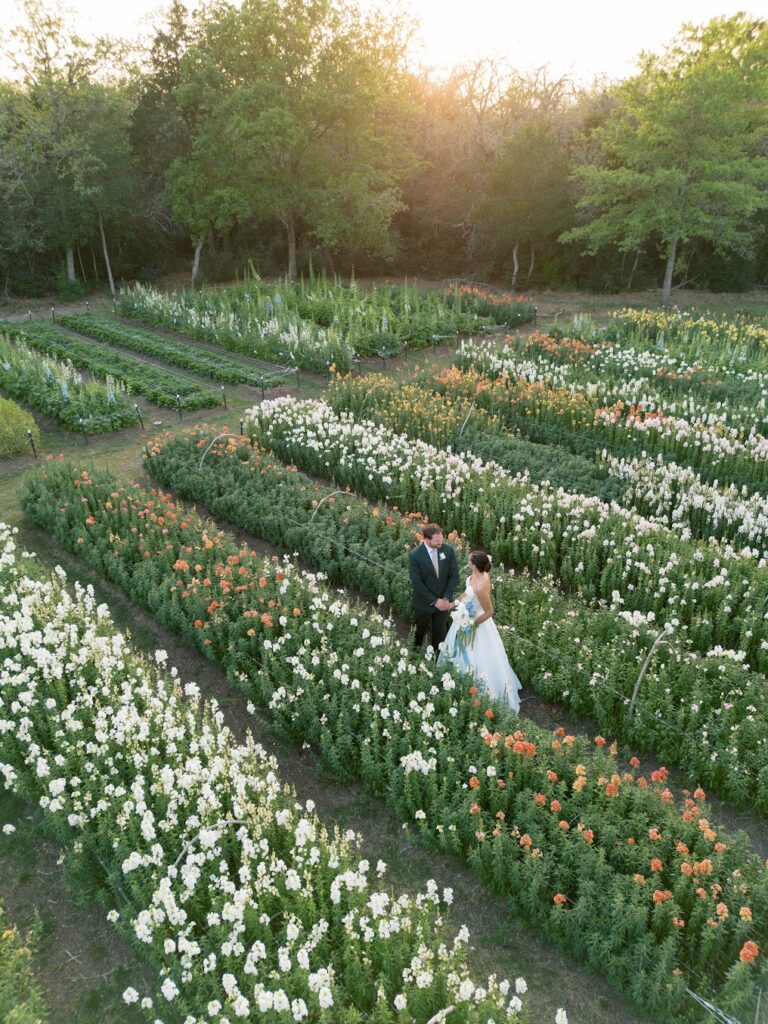
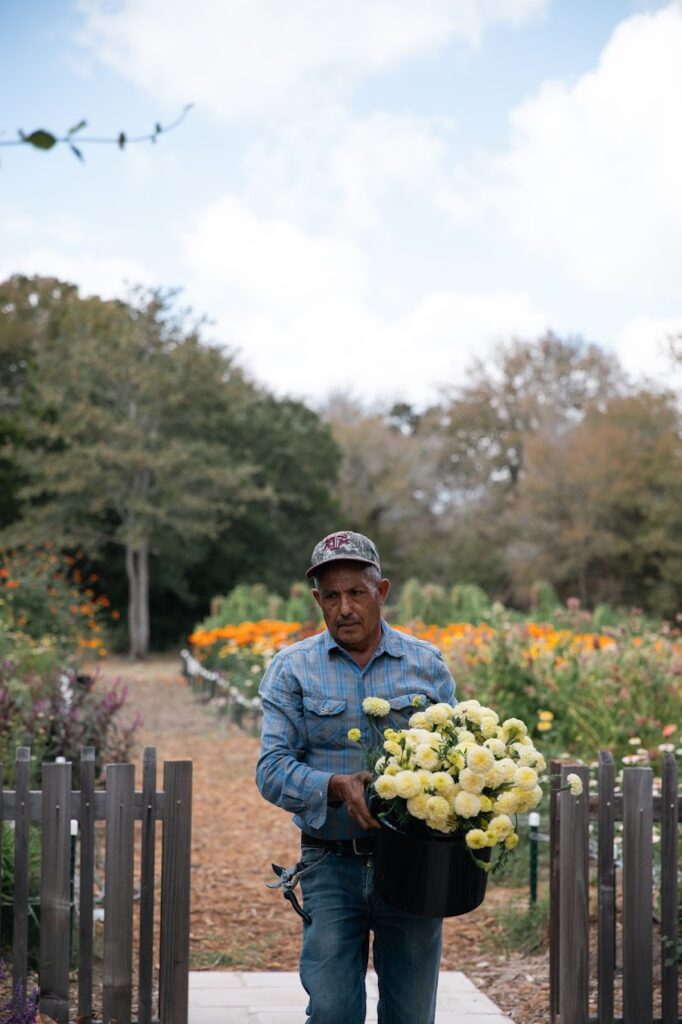
Actually local means something different. It means grown in the same zip code as your wedding. It means someone planted seeds months ago with your celebration in mind. In our case, it means Sean is out in the garden in winter so your May wedding has the right blooms.
What That Journey Costs the Planet
The shorter the supply chain, the smaller the environmental footprint — that part isn’t controversial. Imported flowers are typically grown in heated or cooled greenhouses, harvested, refrigerated, flown, trucked, and refrigerated again before they ever reach a designer’s table. Locally grown flowers skip almost all of that.
In our experience, the difference shows up in two places: the carbon and water inputs to grow the flower in the first place, and the cold-chain energy required to keep it alive in transit. Skip the flight and the multi-day refrigeration, and the math gets noticeably better.
If sustainability is a priority for you, it’s worth knowing that the rest of the floral industry is also working on reducing waste in the design process — from sourcing practices to mechanics to post-event donation. It’s a conversation worth having with whichever florist you choose.
What “Locally Grown” Actually Means When Choosing a Wedding Florist in Austin
There’s a spectrum here, and it’s worth understanding before you start shopping for a florist. “Local” gets used loosely — it can mean anything from “grown in this state” to “we drove to the wholesaler ourselves.” Knowing the actual gradient helps you ask better questions and read the answers honestly.
Level 1: “We source from local wholesalers.” This is the most common version of “local” in the Austin wedding industry. Your florist orders from a Texas-based wholesaler who orders from Colombia, Ecuador, or California. It’s local in the same way your Amazon package is local because it was delivered by someone who lives nearby.
Level 2: “We buy from Texas flower farms.” Better. There are real flower farms in Texas, and some Austin florists do source from them — at least seasonally. The flowers travel less, support local agriculture, and are often grown with fewer chemicals. This is a genuinely good choice.
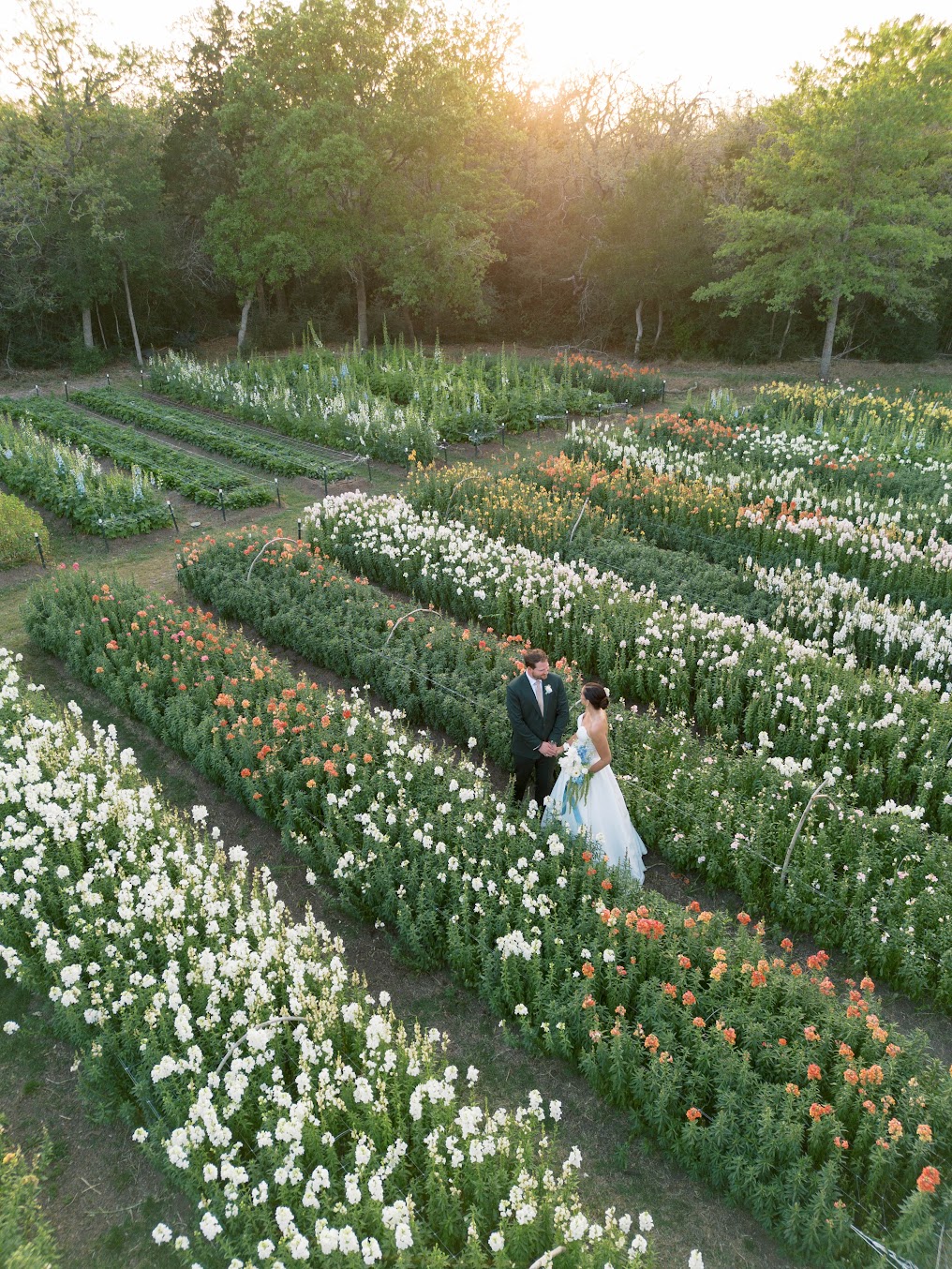
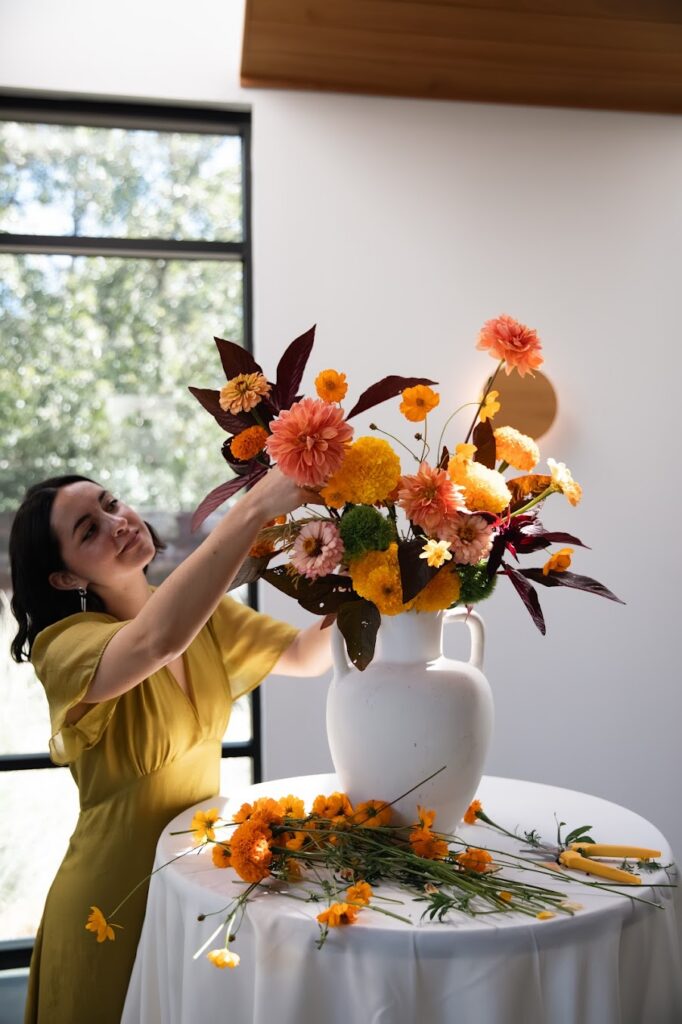
Level 3: “We grow them ourselves, specifically for your wedding.” This is what we do. My husband Sean manages 48 flower beds on our half-acre farm at The Grand Lady — one of very few garden wedding venues in Austin with an actual working flower farm on the property. He plans plantings months in advance based on our couples’ wedding dates and design visions — typically about six months before the event. Our three full-time floral designers then build your arrangements using a combination of what Sean grows on-site and supplemental blooms ordered to fill out the design.
The result, in our experience: arrangements that feel fuller and more abundant than what your budget would typically buy from a florist who sources entirely from wholesalers — because a significant portion of your flowers walked across the property instead of flying across the hemisphere.
If you’d told Sean five years ago he’d be spending his weekends researching dahlia varieties and soil amendments, he would’ve laughed. And yet here he is, fully that person. No regrets.
How to Ask Any Austin Wedding Florist the Right Questions
Whether you end up working with us or someone else entirely, the right questions will tell you how a florist actually thinks about sustainability. None of these should feel confrontational — you’re not auditing anyone. You’re having a conversation about values, and any good florist will be happy to talk about how they work.
1. “Where do most of your flowers come from?” You’re listening for specifics. “We source locally” is vague. “We order from a wholesaler in Dallas who imports from Colombia and Ecuador, and we supplement with seasonal Texas-grown blooms” is honest.
2. “Do you work with any local flower farms?” Some florists have direct relationships with Texas growers. Others don’t. Neither is wrong — but it tells you something about their supply chain.
3. “What’s in season for my wedding date?” A florist who talks knowledgeably about seasonal availability is one who thinks about this stuff. One who says “we can get anything year-round” is telling you they rely heavily on imports.
4. “What happens to the flowers after the wedding?” Some florists offer donation services to hospitals or nursing homes. Some couples repurpose arrangements as guest gifts. Others end up in the trash. Worth knowing.
5. “Can you work with seasonal flowers to reduce my environmental impact?” This question tells you whether sustainability is something they think about at all. The answer will range from “absolutely, here’s how” to a blank stare.
6. “How do you handle waste from your design process?” Stems, leaves, broken blooms — there’s a surprising amount of waste in floral design. Composting is the gold standard. A florist who composts their scraps is one who’s thought beyond the finished arrangement.
Seasonal Flowers in Texas: What’s Blooming When
One of the most effective sustainable choices is simply working with what’s in season. Seasonal flowers don’t need to travel far, they tend to last longer because they weren’t in transit for days, and honestly? They just look better. Flowers that are in their element look like they belong.
Here’s a rough sense of what grows in Central Texas by season — based on what we actually see in our garden, not a generic chart from a seed catalog:
Spring (March – May)
Peak season for Texas flowers and peak wedding season. Lucky timing. Spring is when the early-season blooms come in — the soft, romantic, cool-weather varieties that brides usually picture first when they think “garden wedding.”
Summer (June – August)
Texas heat is real, but so are summer blooms. Summer leans into the heat-tolerant workhorses — vibrant, abundant, and built for the conditions.
Fall (September – November)
The other peak wedding season, and the garden’s second act. Fall is the rich-toned dahlia moment, plus the deeper, moodier varieties that make autumn arrangements feel layered and intentional.
Winter (December – February)
A slower growing season in Central Texas.
- Evergreens, dried florals, textured branches
- Supplemental blooms are a bigger part of winter arrangements — and that’s okay
The point isn’t that every flower in your arrangement needs to come from a garden down the road. It’s that when you design with the seasons, you naturally reduce your environmental impact — and you end up with arrangements that feel more intentional, not less. (If you want to see what the beds actually look like across the year, our cut flower garden photos are the closest thing to walking the rows yourself.)
Beyond Flowers: Other Eco-Friendly Wedding Choices that Actually Matter
Flowers are one piece of the sustainability puzzle, not the whole thing. Guest transportation, food sourcing, and energy use are all bigger pieces of a wedding’s overall footprint. But florals are an easy lever to pull, and choosing local flowers often gets you more for your money, not less. That’s a rare combination.
Here are a few other choices that genuinely move the needle — without requiring you to turn your wedding into a TED talk about climate change.
Food sourcing. Ask your caterer where they source protein and produce. Farm-to-table in Austin isn’t hard — there are incredible local farms and ranches. Seasonal menus are also cheaper, which is a nice bonus.
Digital over paper where it counts. Digital RSVPs, online registries, and QR codes on day-of signage eliminate a surprising amount of paper waste — and your guests will actually prefer it. Save the beautiful paper for the invitation itself if that matters to you.
Guest count. I know this one is politically complicated. But every guest added increases food, drinks, paper goods, transportation emissions, and waste. A smaller guest list isn’t just intimate — it’s genuinely lower impact. (Also: less drama. But that’s a different blog post.)
Decor reuse. Rent instead of buy. Repurpose ceremony florals at the reception. Donate arrangements to a local hospital or senior center after the event. These aren’t sacrifices — they’re just good planning.
The couples I talk to who care about sustainability aren’t trying to be perfect. They’re trying to be thoughtful. And thoughtful choices, made consistently, add up to something real.
Frequently Asked Questions About Sustainable Wedding Flowers in Austin
The short version: locally grown, seasonal flowers have a smaller environmental footprint than imported imports — and when you work with a farmer-florist, your arrangements often end up fuller for the same budget. Here are the questions we hear most often from couples planning sustainable weddings in Austin.
Locally grown, seasonal, field-grown flowers have the lowest environmental impact. In Austin, spring and fall offer the widest variety of locally grown options. Working with a florist who sources from Texas flower farms — or grows their own, like Grand Lady Floral — meaningfully reduces the travel and cold-chain energy that imported flowers require.
Sustainable flowers aren’t necessarily more expensive. Because we grow a significant portion of your flowers on our farm and supplement with ordered blooms only as needed, your arrangements are often fuller than what the same budget would buy from a florist who sources entirely from wholesalers. Prices vary by design complexity and season. Couples who book Grand Lady Floral also receive a $500 discount on venue rental at The Grand Lady.
A traditional florist orders flowers from wholesalers and designs arrangements. A farmer-florist grows some or all of their own flowers and designs with them. Grand Lady Floral is a farmer-florist model — our team of three designers works with flowers grown on our half-acre farm, supplemented with ordered blooms to complete each design vision.
Yes. Sustainability doesn’t mean sparse — it means sourcing thoughtfully. When flowers are grown on-site rather than shipped internationally, the savings in transportation and cold-chain energy free up budget for more abundant designs. In our experience, our couples regularly tell us their flowers exceeded expectations.
We typically see couples book us 9-16 months out, and our farm planning happens about six months before your wedding date. For peak Spring (March-May) and Fall (October-November) dates, earlier booking gives us more flexibility to grow specific varieties for your vision.
The Grand Lady is a wedding venue in Austin, Texas, an 1881 mansion on 20 acres about 25 minutes east of downtown. Grand Lady Floral is an in-house floral studio with three full-time designers and a half-acre on-site cut flower farm.
+ view the comments