Garden wedding venues in Austin: the trap to avoid
Most “garden wedding venues” in Austin aren’t actually gardens — they’re outdoor venues with some landscaping. The phrase gets used loosely to describe anything from a working flower farm to a lawn with a topiary. Until you’ve toured a few, it’s almost impossible to tell from a website what kind of “garden” you’re actually getting. Here’s how to tell them apart before you book.
Here’s a thing nobody tells you when you start searching “garden wedding venue Austin.”
Most of them aren’t actually gardens.
I don’t say that to be mean. I say it because I’ve watched couple after couple show up to tour Grand Lady after spending weeks on Pinterest, saving photos of the wedding they’re picturing — long table under string lights surrounded by waist-high flowers, bride walking through a field of blooms, a ceremony aisle that’s actually flanked by living flowers planted into the ground next to it — and they always say some version of the same thing on the tour: “This is what we kept seeing in photos, but every venue we toured was just a yard with some bushes.”
That’s the trap. The phrase “garden wedding venue” gets used for almost any venue with a tree and a lawn. It can mean a working flower farm. It can also mean an outdoor space that put a topiary near the entrance and called it a day. And until you’ve toured a few, it’s almost impossible to tell from a website what you’re actually getting.
So this is the post I wish more couples had before they started touring (along with our 74 questions to ask your Austin wedding venue). What “garden wedding venue” actually means, the three categories you’ll run into in Austin, and why one of them — the rarest one — is wildly different from the other two.
I should say upfront: I’m wildly biased. We run one of these. But I’m going to try to make the case fairly, and if you read this and decide a different category fits you better, that’s a good outcome too. The whole goal here is helping you not get to your wedding day disappointed.
Let’s get into it.
The 3 types of garden wedding venues in Austin: a quick taxonomy
There are three categories of “garden wedding venue” in Austin, and they’re wildly different. Type 1 is an outdoor venue with grass and trees but no actual garden. Type 2 has ornamental landscaping — boxwoods, climbing vines, decorative plants. Type 3 is a working cut flower farm where the flowers in your bouquet were grown on-site for your wedding. Only one venue in Austin fits Type 3.
Before you tour anything, it helps to know there are essentially three categories hiding under the same label.
Type 1: Outdoor venue with grass and trees
This is the most common. A nice piece of land. Some big oaks. Maybe a lawn. Possibly a wraparound porch. The “garden” branding is doing some heavy lifting here — there is no garden. There’s just outside.
Outdoor venues can be beautiful. But if you’re looking for a real garden experience, this isn’t it. The flowers in the photos came from your florist’s wholesaler, and the venue is essentially a backdrop, not a contributor to the floral story.
You’ll know it’s this category if: the website talks about “lush grounds” and “mature trees” but doesn’t show actual planted gardens in any of the wedding photos. Or if you ask “do you grow flowers here?” and the answer is “we have landscaping.”
Type 2: Landscaped venue with planted ornamental gardens
A step up. These venues have actually planted things — boxwoods, ornamental grasses, maybe some climbing roses or wisteria on a pergola. The grounds look intentional. There are real plants, in real beds, that real gardeners maintain.
This category gets closer to the Pinterest dream, but there are two big gaps. First, the plants are ornamental, not cutting flowers — they’re there to make the venue look nice on tour, not to end up in your bouquet. Your wedding flowers still come from a wholesaler, usually flown in from somewhere far away. Second, the gardens at these venues are almost always small. A planted corner. A border. A trellis. They’re pretty, but they’re not the immersive, expansive, one-with-nature experience couples are picturing when they search “garden wedding venue.” You can’t get lost in a flower bed.
You’ll know it’s this category if: the gardens look nice in the venue photos but never show up in the actual wedding photos, and the “garden” you walked through on the tour was the size of a small patio.
Type 3: Working cut flower farm wedding venue
This is the rare one.
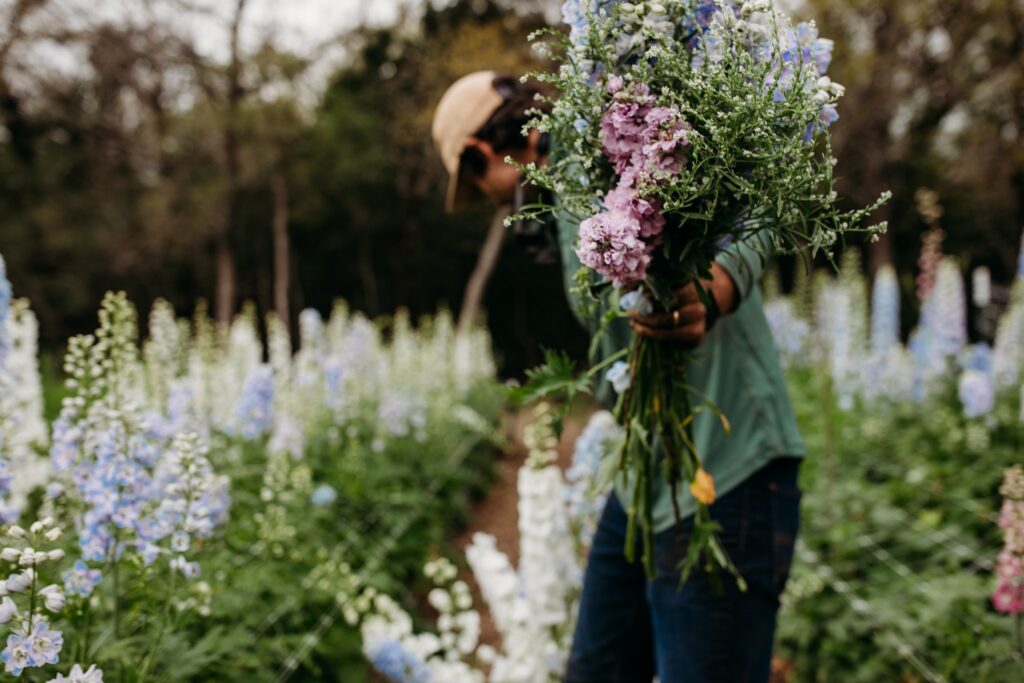
A working cut flower farm venue grows the actual flowers that go into your wedding, on-site, specifically for you. Not landscaping. Not pretty plants. Cutting flowers — the kind grown for the express purpose of being harvested, designed into arrangements, and put in someone’s hands on a wedding day. At Grand Lady, that’s a half-acre of cut flowers in 48 raised beds, planted six months before your wedding to match your design board.
When the venue is a flower farm, the entire economic and creative model changes. The flowers in your bouquet were grown on the property they’re being carried across. The arrangements feel impossibly fresh. And there’s a thing that happens when you actually walk into the garden — and I’m not exaggerating, our couples bring it up every single tour — your heart rate just slows down. Something about being surrounded by that much living color, in that much quiet, with the soft sound of leaves moving and bees doing their thing, does something to a person’s nervous system. (I cannot promise it will cure your wedding-day anxiety. But on a day when the rest of your life is in a Google Sheet and your group chat is on fire, walking back into the garden is the closest thing to a chill pill I have ever found on this property.)
You’ll know it’s this category if: when you ask “where do these flowers come from?”, the answer involves a tour of the cutting beds — not a list of suppliers.
Most “garden wedding venues” you’ll find on directory sites are Type 1 or Type 2. Type 3 is rare anywhere — and in Austin, we are the only one. (Truly. We’ve looked. If a working cut flower farm wedding venue ever opens in Austin, I’ll buy them flowers.)
Garden wedding venues in Austin: what couples actually mean when they search
When couples search “garden wedding venue Austin,” they’re almost always picturing a working flower farm — long tables under string lights, blooms taller than the bride, ceremony aisles flanked by living flowers. That visual language is shaped by farm content, not landscaping content. Touring a Type 1 or Type 2 venue can feel disappointing because the bar was set somewhere different than where the venues are trying to land.
If you’ve been on Pinterest for any amount of time, you already know what kind of wedding you’re picturing. It’s the one where the bride is standing in a field of blooms taller than her shoulders, and the photos look like they came out of a Vogue editorial, and there’s a long table at the reception with stems trailing down the middle and candles flickering and you can almost hear the conversation buzzing in the background. (We have those photos, by the way. They’re real. They were taken at Grand Lady. I’ll show them to you on the tour.)
Here’s the thing about that image: nine times out of ten, the venue in those photos is a working flower farm. Not a landscaped venue. Not an outdoor venue. A farm.
It’s not that the other categories can’t host a beautiful wedding — they absolutely can. It’s that the specific aesthetic couples are usually chasing when they type “garden wedding venue” into a search bar is, almost always, a Type 3 venue. The visual language of that search is shaped by farm content. Couples just don’t always know that’s what they’re looking at.
Which is why touring a Type 1 or Type 2 venue can feel weirdly disappointing even when the venue itself is gorgeous. You’re not measuring it against other outdoor venues — you’re measuring it against a Pinterest board that was built almost entirely from flower farm photographs. The bar was set somewhere different than where the venues were trying to land.
Garden wedding venues in Austin: the hidden cost without a real garden
When the venue’s “garden” is actually landscaping, you end up paying for two gardens — the ornamental one that doesn’t contribute to your wedding, and the one your florist had to import from a wholesaler. When the venue is the garden, most of that cost compresses, the flowers are dramatically fresher, and couples usually get lusher arrangements for the same budget.
Let’s talk about money for a second, because this is the part that doesn’t get explained enough.
When the venue’s “garden” is actually landscaping, the flowers in your wedding still have to come from somewhere. Your florist will source them from a wholesaler — usually shipped in from South America, sometimes from California or the Netherlands, and almost always trucked through a refrigerated supply chain that’s days long by the time anything reaches Austin. You pay for the flowers, you pay for the shipping, you pay for the refrigeration, you pay for the labor of someone receiving and processing them. Then you also pay the venue to look like a garden.
You’re essentially paying for two gardens. The one that’s not contributing to your wedding (the landscaping), and the one that is (the one your florist had to import).
When the venue is the garden, most of that compresses. We do still order in some flowers from wholesalers when a client’s vision calls for varieties we don’t grow on the farm — that’s part of the model, and we’re not trying to pretend otherwise — but the percentage is dramatically lower than at a typical Austin floral studio, because the farm does so much of the heavy lifting. The flowers we do grow were planted for your wedding specifically. They were harvested days before, not flown across continents the week before. There’s no jet lag. No week of refrigeration making the petals weaker by the day. (If you want the deeper version of this argument — the supply-chain math, the sourcing tradeoffs, the carbon footprint of imported stems — read a deep dive on sustainable wedding flowers in Austin.)
And — this is the part that surprises couples the most — you usually get more flowers for the same budget. Lusher arrangements. Bigger bouquets. Stems that look alive because they actually still are. That’s not a magical thing. It’s just math: cutting out most of the supply chain leaves more value in the room where the wedding is happening. The other piece of it is that we have thousands of flowers in the ground at any given time during peak season, and we genuinely want couples to enjoy them. It’s a much better feeling for everyone when the garden is being used than when it’s just sitting there looking pretty.
Garden wedding venues in Austin: why Texas is hard, and why Sean is the reason ours works
Texas is a brutal place to grow cut flowers — clay soil, summer heat, unpredictable freezes. Most floral varieties couples want at weddings (delphinium, ranunculus, sweet peas, garden roses, dahlias) aren’t native to Central Texas. Sean, my co-owner and husband, taught himself how to grow them anyway. Five years in, he grows delphinium that’s eight feet tall. That’s why our garden works.
I want to be honest about something else.
Texas is a terrible place to grow cut flowers. I am not exaggerating. Most of the floral varieties couples want at their weddings — delphinium, ranunculus, sweet peas, garden roses, dahlias — are not native to Central Texas and don’t particularly want to be here. The summer heat is brutal. The clay soil fights you. We get unpredictable freezes in the winter and weeks of 100-degree afternoons in the summer. Most Texas growers can’t pull off the kinds of stems you see in editorial wedding photography. They give up and grow what’s easy.
This is the part where I get to brag about my husband, so brace yourself.
Sean is my co-owner and the reason the garden at Grand Lady actually works. He had no agricultural background when we started this. Zero. He didn’t grow up on a farm. He didn’t go to school for horticulture. He learned how to grow cut flowers in Central Texas the hard way — by reading everything he could find, talking to growers in other states, killing a lot of plants in the early years, taking soil samples, adjusting, killing more plants, adjusting again, and slowly, season by season, figuring out what would actually thrive on our particular half-acre.
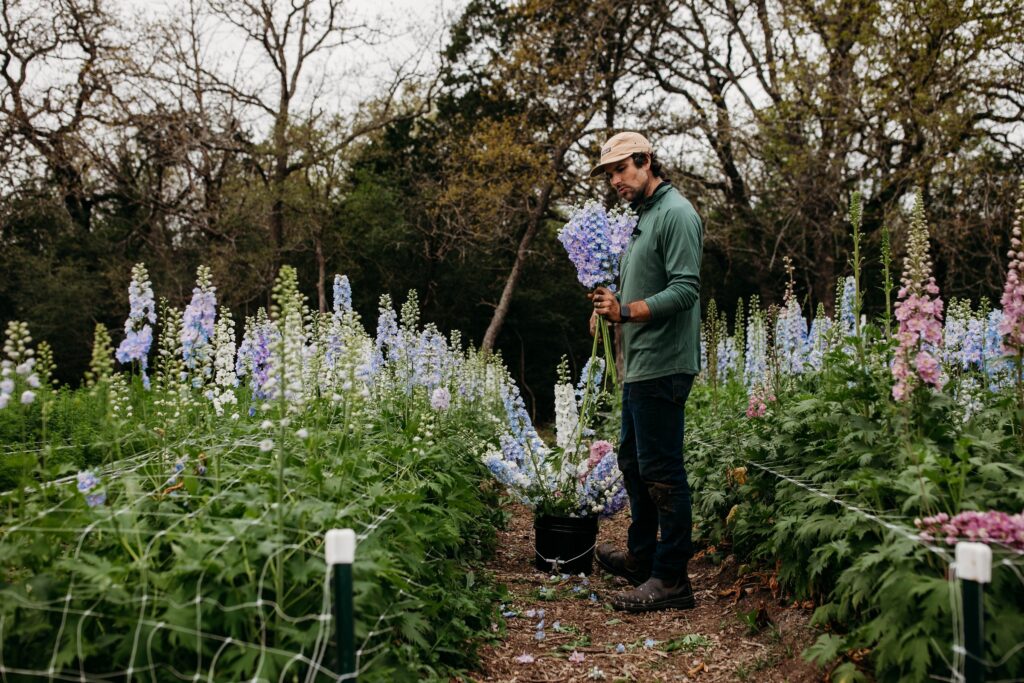
Five years in, he grows delphinium that’s eight feet tall.
I want you to picture that for a second, because it’s genuinely absurd. Eight feet tall. In Texas. Delphinium is famously finicky. Most growers in our climate can’t get it past three feet, and they certainly can’t get it to come back season after season. Sean has somehow created the conditions where ours not only survives but towers over the grandkids at every wedding.
If you’d told me five years ago that my husband would spend his weekends obsessing over soil pH and dahlia varieties, I would’ve laughed. He would’ve laughed too. And yet here he is, fully that person, with the suntan and the dirt under his fingernails and the very specific opinions about cover crops. No regrets.
The point of the Sean story isn’t just that he’s great (though he is). The point is that the reason most “garden venues” in Austin can’t actually pull off the seed-to-ceremony thing is that it’s really hard. You need somebody with the patience to fail repeatedly, the obsession to keep going, and the willingness to plant things that everyone says won’t grow here. We have that person. We are very lucky to have that person.
And if the garden looks the way it does — if the photos look the way they do, which we’ll get to in a minute — it’s because Sean decided to figure it out.
Garden wedding venues in Austin: the photo opportunities nobody warned you about
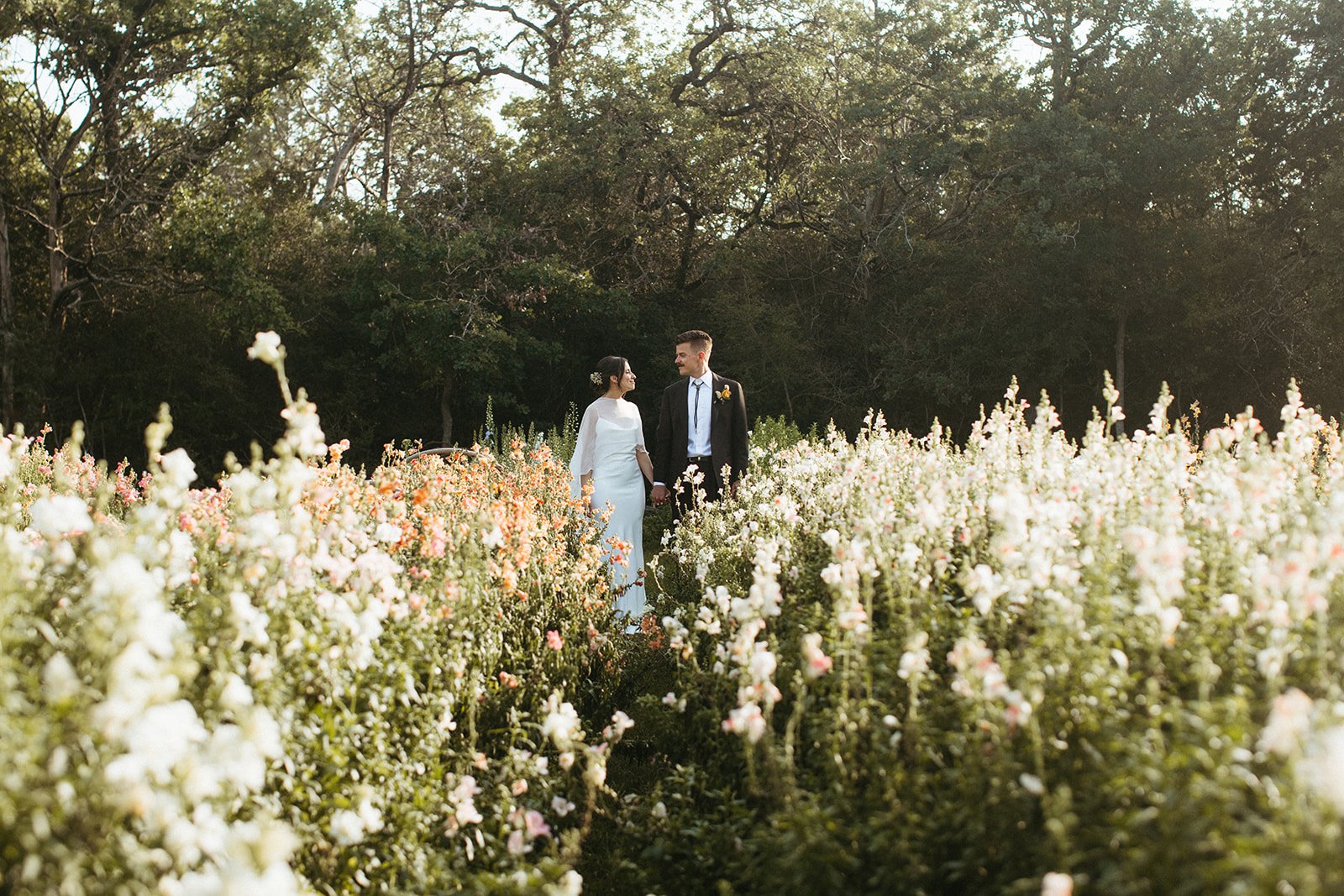
A working flower farm produces wedding photos that look fundamentally different from landscaped venues. There’s depth, dimension, and color you can’t fake — six feet of blooms behind the subject instead of a flat backdrop. Bridal portraits in fields of flowers, couples walking between rows of snapdragons, the under-the-pergola shot — these are images that could only have happened on this property in this season with these specific flowers.
Here’s the part I underestimated when we built the farm.
We knew the flowers would be valuable to couples for the obvious reasons — fresher arrangements, more for your money, the seed-to-ceremony story, the sustainability angle. What I didn’t see coming was what the garden would do for photographs.
I’m going to try to describe this without sounding like I’m overselling it, but I’m probably going to fail.
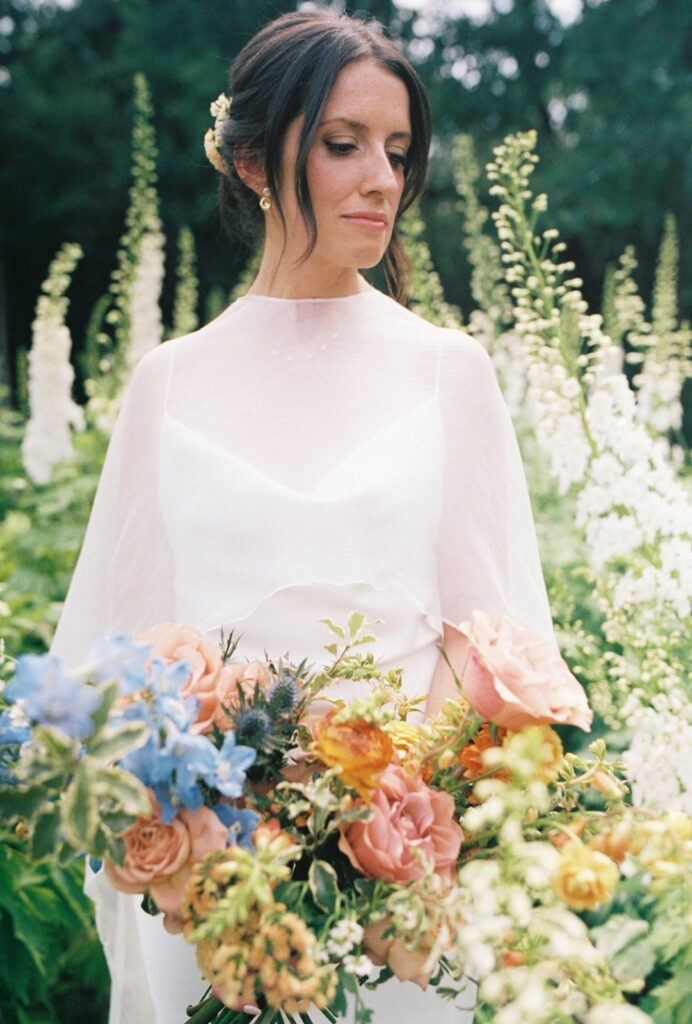
When the beds are in full bloom — which, thanks to Sean’s planting plan, is most of the wedding season — the garden becomes the most photographed location on the property. Photographers love it because the light moves through the flowers in a way it doesn’t move through landscaping. There’s depth. There’s color you can’t fake. There’s actual dimension behind the subject — six feet of blooms instead of a flat backdrop.
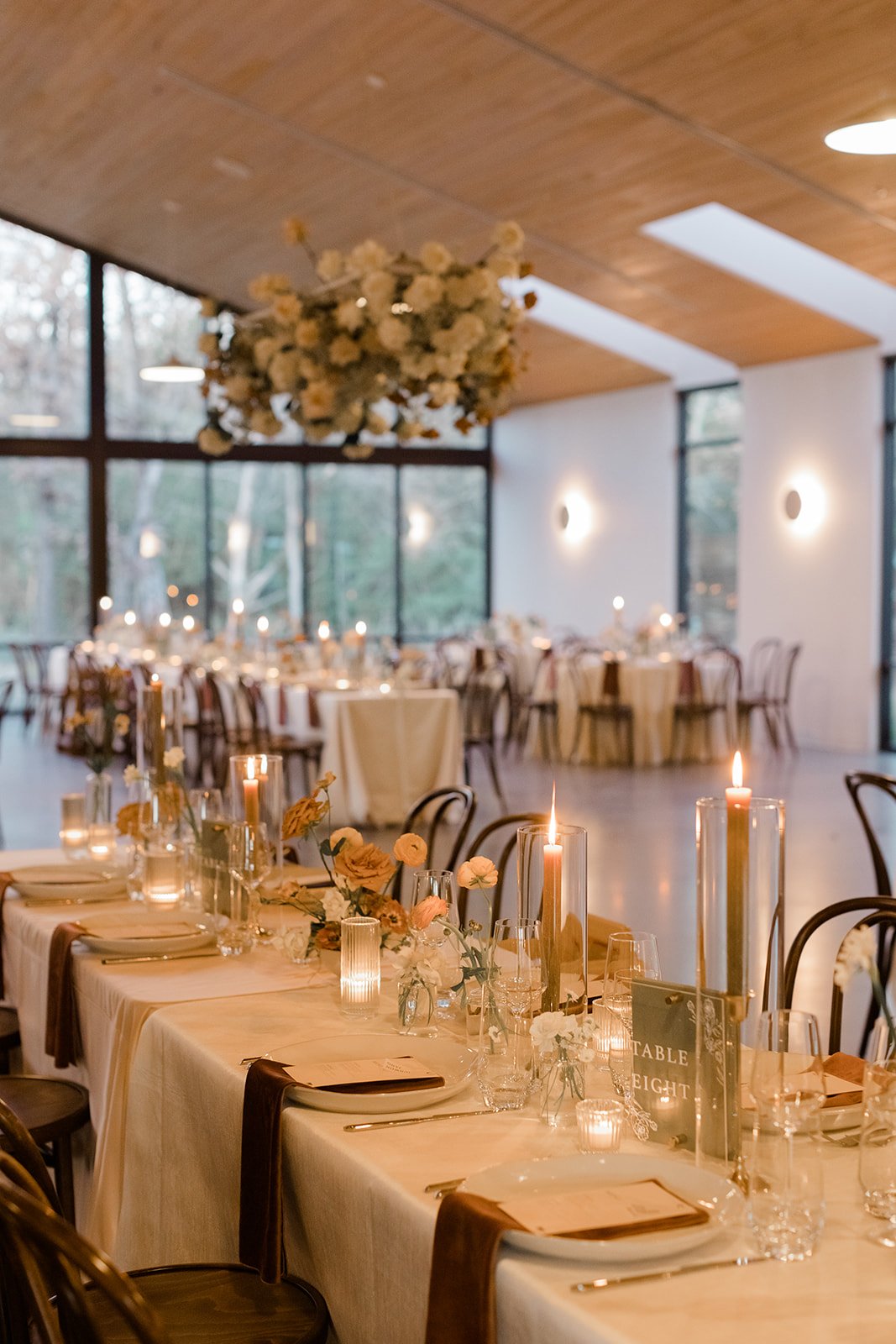
The shots that have started to go viral from Grand Lady weddings are almost all garden shots. Bridal portraits in a field of blooms taller than the bride’s shoulders. Couples walking the path between rows of snapdragons and bells of ireland. The under-the-pergola shot, where the 60-foot pergola frames the garden behind the couple and the whole thing looks like a movie set. Cocktail hour photos with guests holding champagne four feet from a wall of flowers. Long-table reception shots where the garden is right there, just outside the frame, and you can feel it even if you can’t see it. (You can see the cut flower garden photos in our garden gallery if you want a sense of what those shots actually look like.)
I want to be specific about why this matters. Most wedding venues — even gorgeous ones — produce photos that look like other wedding photos at other venues. Beautiful, but interchangeable. The garden produces photos that look like your wedding, because they could only have happened on this property in this season with these specific flowers. There’s no other venue in Austin that produces the same images, and your photographer will absolutely tell you so.
If you’re someone who is going to want to look at your wedding photos for the next 50 years, that matters a lot.
Working cut flower farm wedding venue in Austin: what it actually looks like
The Grand Lady’s cut flower garden is half an acre, with 48 raised beds organized into rows you can walk between, and a 60-foot pergola at the entrance. The garden is tucked at the back of the property, accessed by mulched paths through the woods — couples call it the “secret garden.” The planting plan is built around our wedding calendar; flowers are planted about six months before each wedding to match the couple’s design board.
Let me get specific about the property, because I keep saying “working flower farm” and I want to show you what that means in practice.
At Grand Lady, the cut flower garden is half an acre, with 48 raised beds organized into rows you can walk between. The 60-foot pergola sits at the entrance — it’s the endcap, the threshold you walk through to step into the garden. The garden itself is tucked at the back of the property — our couples call it the “secret garden” — accessed by mulched paths that wind through the woods from the main grounds. The walk back is part of the experience: it’s quiet, the trees do the work, and by the time you arrive at the pergola you’ve already left the rest of the day behind. (Most of our couples cry the first time, and they haven’t even gotten engaged yet on the tour.)
The planting plan is built around our wedding calendar, not the other way around. Every season, our floral team looks at upcoming clients’ design boards and decides what to plant, in what quantities, in what colors, to support those specific weddings. Most weddings have their flowers planted about six months out, so couples who book a year or more in advance will see the actual ground their flowers grow in long before the seeds go in. Spring weddings get spring blooms grown specifically for them. Summer and fall weddings get the same.
The farm doesn’t provide every single flower at every wedding — when a client’s vision calls for varieties we don’t grow, or quantities that exceed what the half-acre can produce, we supplement with wholesale ordering like any other florist. But the supplemental piece is much smaller than at a traditional Austin studio, because the farm covers so much. Every wedding we host features farm-grown flowers from the property, and the design starts from the question of “what’s in the ground for this couple” instead of “what can we order in this week.”
That’s the difference. It’s not theater. It’s the actual operating model.
A real day at a garden ceremony in Austin: how it actually unfolds
The bulk of the floral harvest happens five to six days before the wedding, not the morning of — that’s standard for high-end floral work, giving stems time to drink, recover from the cut, and be at peak performance. On the wedding day itself, the floral team builds arrangements in the studio with conditioned stems, while you walk the woods path back to the garden for first-look photos surrounded by the same varieties that are in your bouquet.
Here’s what the days leading up to a wedding day look like when your flowers were planted six months ago specifically for you.
Five to six days before the wedding. This is when the bulk of the harvest actually happens. Sean or Francisco — our farm team — go out to the cutting beds and harvest the stems we need for the wedding: bouquets, boutonnieres, ceremony pieces, centerpieces, the works. The cuts are made early when the flowers are at peak hydration, before the heat hits. Buckets of stems come into the studio, where they’re conditioned, hydrated, and prepared. (Cutting days in advance is the standard for high-end floral work — it gives the stems time to drink, recover from the cut, and be at their absolute best on wedding day. The myth that fresh-cut means “cut that morning” is one of the things I’m most consistently trying to correct in this industry.)
The morning of the wedding. The floral team is in the studio building your specific arrangements. If something extra-special is needed — a bloom that looked particularly perfect that morning, a stem the bride asked for after the design was finalized — a designer might pop out to the garden for a few last-minute cuts. But the bulk of the work is happening in the studio, with stems that have been conditioning for days and are ready to perform.
Pre-ceremony. You walk back through the woods to the garden for first-look photos. The same varieties that are in your bouquet are still in the ground around you. The photographer starts grinning. (They always do. It’s a thing.) The light through the flowers does the work that no photo backdrop can replicate.
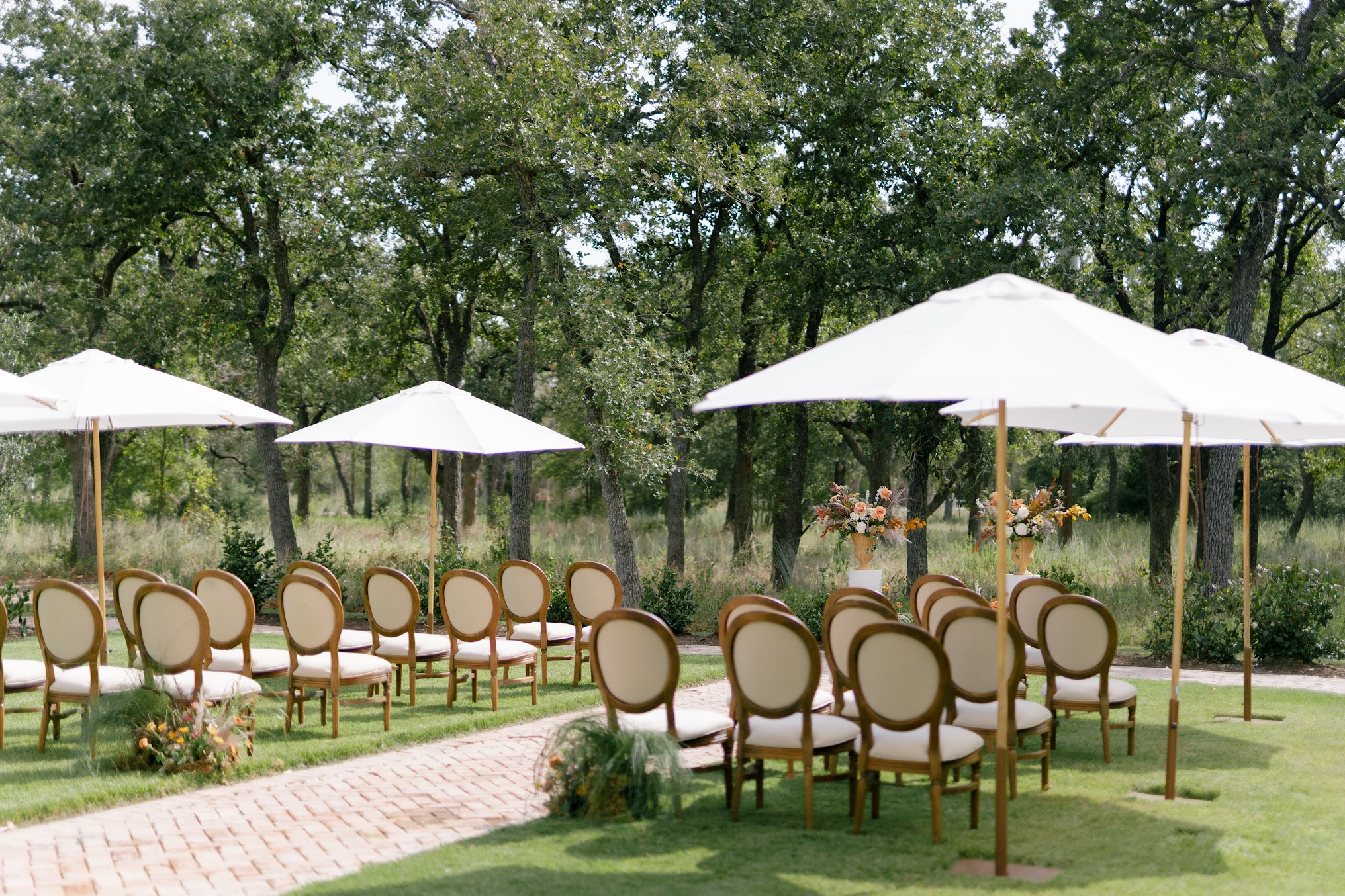
Ceremony. Many of our couples choose to get married right in the garden, under the pergola, surrounded by the cut flowers themselves. Others choose the ceremony lawn at the front of the mansion. Either way, the garden is part of the day — but you have to be intentional to walk back there. It’s tucked at the back of the property, and the walk through the woods is its own moment. That distance is part of why it feels the way it does.
Reception. Your centerpieces still smell like the garden. Some of your guests will figure this out and lose their minds. The flowers don’t have that slightly-tired look you get from imported stems. They’re still alive and they look alive.
That’s the model. It’s a small thing in some ways and a huge thing in others. I think most couples don’t realize how much of the wedding experience is shaped by where the flowers came from until they have a wedding where they came from a quarter-mile away instead of across the world.
Garden wedding venues in Austin: which type is right for you?
A working cut flower farm venue is the right fit for couples who care deeply about photo opportunities, fresh farm-grown stems, the sustainability of locally-grown flowers, and the visceral “I want my flowers to come from where I’m getting married” feeling. If the floral story isn’t a top-three priority and you mostly want a beautiful outdoor space with great trees, a Type 1 or Type 2 venue will probably make you happier — and probably cost less.
If any of this resonated — the photo opportunities, the value of farm-grown stems, the sustainability story, the visceral “I want my flowers to come from where I’m getting married” feeling — then yes, you probably want a Type 3 venue. There aren’t many in Austin (we know of exactly one, and you’re reading its blog), but it’s worth touring at least one to see whether the difference feels as big in person as it sounds on paper. It usually does.
If what you actually want is a beautiful outdoor venue with great trees and a nice porch, and the floral story isn’t a top-three priority for you — that’s totally valid, and a Type 1 or Type 2 venue will probably make you happier and probably cost less. Don’t let anyone (including me) talk you into something you don’t want.
And if the choice you’re actually wrestling with is between an old building and a new one, that’s a different fork in the road — covered separately in historic vs. modern wedding venues in Austin, which makes the case for the “both/and” venues that don’t ask you to pick a side.
If you’d like to schedule a tour at The Grand Lady and see what a working flower farm venue actually feels like, we’d love to have you. Sean will probably be in the garden when you arrive. He’ll definitely want to tell you about the delphinium.
One more thing, while we’re here. Even if you don’t end up booking Grand Lady for your wedding, the garden is still available for photoshoots — engagement sessions, bridal portraits, family photos, anniversaries, branding shoots, you name it. We host a steady rotation of photographers using the garden as a backdrop for couples and clients who fell in love with the space and wanted a piece of it for their photos even though their wedding was happening elsewhere. If you’re a photographer or a couple who just wants the garden for an hour, get in touch — we love this part of the business too.
Frequently asked questions
The Grand Lady is a family-owned wedding venue in Austin, Texas, operated by Katie West and Sean Kane. The 1881 mansion sits on 20 acres about 25 minutes east of downtown Austin and includes a fully restored historic structure, a modern climate-controlled reception hall, and a half-acre working cut flower farm with 48 raised beds. To schedule a tour at The Grand Lady, pick a time that works for you.
An outdoor wedding venue is any venue with usable outdoor space — lawns, trees, porches, courtyards. A garden wedding venue, in the most literal sense, is a venue with intentionally planted gardens — which can range from ornamental landscaping to a working cut flower farm. The label “garden wedding venue” is used loosely in the industry, so it’s worth asking specifically what kind of garden the venue actually has and whether the plants on the property contribute to the wedding florals.
No — there is exactly one. The Grand Lady, an 1881 wedding venue in Austin, Texas, is the only Austin wedding venue with a working on-site cut flower farm. Our half-acre garden has 48 raised beds and a 60-foot pergola, and flowers are planted specifically for the couples getting married on the property. Other Austin venues have ornamental landscaping or small planted gardens, but no other full wedding venue in Austin grows cutting flowers for use in its couples’ weddings.
Most do not. The vast majority of “garden wedding venues” in Austin have ornamental landscaping — hedges, climbing vines, and decorative plants — but they do not grow cut flowers for use in wedding arrangements. Couples at those venues still source their wedding flowers through a florist’s wholesaler, which typically means imported stems shipped through a refrigerated supply chain. A true working flower farm venue is the exception, not the rule.
The best months for garden weddings in Austin are typically March through June and September through November, when temperatures are mild and the widest variety of cutting flowers is in bloom. Spring weddings often feature ranunculus, sweet peas, anemones, snapdragons, and delphinium. Fall weddings center on dahlias, snapdragons, marigolds, and late-season blooms. Summer weddings (June through August) lean into the heat-loving varieties: zinnias, cosmos, celosia, sunflowers, and gomphrena — flowers that actually thrive in Texas summers and produce some of the most colorful bouquets of the year.
Pricing varies by venue and season. At The Grand Lady, venue packages range from $4,000 to $14,500, varying by day of week and season — with peak Saturday rates in spring and fall at the high end and weekday and off-season dates at the low end. Taxes & fees not included. Book with Grand Lady Floral for a $500 discount on venue rental, plus access to flowers grown on-site for your specific wedding date. Floral package pricing depends on guest count and design preferences. For the full month-by-month pricing breakdown, request our pricing guide.