Written by Katie West, co-owner of The Grand Lady, an 1881 wedding venue on 20 acres in Austin, Texas.
Historic vs. Modern Wedding Venues in Austin: The Decision Every Couple Agonizes Over
Torn between historic wedding venues and modern wedding venues in Austin? Here’s the honest tradeoffs of each — plus the third option most couples miss.
Most Austin couples don’t realize the historic-vs-modern choice is a real fork in the road until they’re three venues deep and starting to panic. Historic venues sell on character and story; modern venues sell on comfort and predictability. Both are legitimate, both have honest tradeoffs, and a small number of Austin venues offer both on the same property — which most couples don’t know is an option.
Here’s how it usually goes.
You tour a historic wedding venue first. The kind with creaky wood floors and a wraparound porch and a getting-ready room that feels like a movie set. You take pictures of the original stain glass. You whisper to your partner, “Babe, this is it.” On the drive home you start writing the seating chart in your head.
Then a few days later, you tour a modern wedding venue. Maybe it’s all clean lines and floor-to-ceiling glass and a reception hall that looks like a magazine spread. The AC hits you when you walk in, and you remember it’s going to be 94 degrees on your wedding day, and your grandmother is 87, and suddenly you’re not sure anymore.
By the time you get back to your car, you have two text threads going with your mom and three Pinterest boards open and a slow, creeping dread that you’re about to have to choose between two completely different weddings.
This is the part of venue shopping nobody warns you about.
I see it all the time. Couples come tour Grand Lady after spending a month bouncing between historic mansions and modern reception halls, trying to figure out which kind of wedding they actually want. Most of them assume it’s a binary choice. Historic couples and modern couples. Pick a side.
I’m here to tell you it’s not actually a binary choice. We built Grand Lady around exactly this problem — a fully restored 1881 mansion and a modern climate-controlled reception hall on the same 20 acres — because we kept watching couples get stuck having to choose. So what follows is partly a framework for figuring out which way you should lean, and partly the case for the third option most couples don’t know exists. Even if you end up at a venue that’s purely one or the other, you should at least know what you’re trading away.
Let’s get into it.
Historic Wedding Venues in Austin: What You Actually Get
A historic home wedding venue gives you a built-in story, photos with architectural character, getting-ready spaces that feel like real rooms, and a venue doing 70% of the design work for you. The honest tradeoff: most historic Austin mansions don’t have a reception building, which means dinner and dancing usually happens in a tent ($12,000+ once outfitted) or a separate location.
Historic venues are popular for a reason. Walk into a 19th-century mansion and there’s something in your nervous system that just settles. It feels like the wedding has already started. Like the building knows what it’s doing.
Here’s what that gets you in real life:
A built-in story. Every historic venue has one — when it was built, who built it, what it’s been through. That story becomes part of your wedding without you having to do anything. Couples brag about it to their friends, drop it into the “where we’re getting married” story they end up telling 200 times during their engagement, and reference it in their toasts. It’s free narrative your venue is just handing you. (Ours, for the record, was originally built in 1881 as a wedding gift — which means it’s been part of weddings since the day it existed. I will never get tired of that.)
Photos with character. Photographers love historic venues for a reason. The light is different in old buildings. The architecture has details — high ceilings, trim, hand-carved staircases, porches with peeling paint that catches the afternoon sun — that you literally cannot replicate in a new build. Your photos will look like yours, not like every other wedding shot in a clean white box.
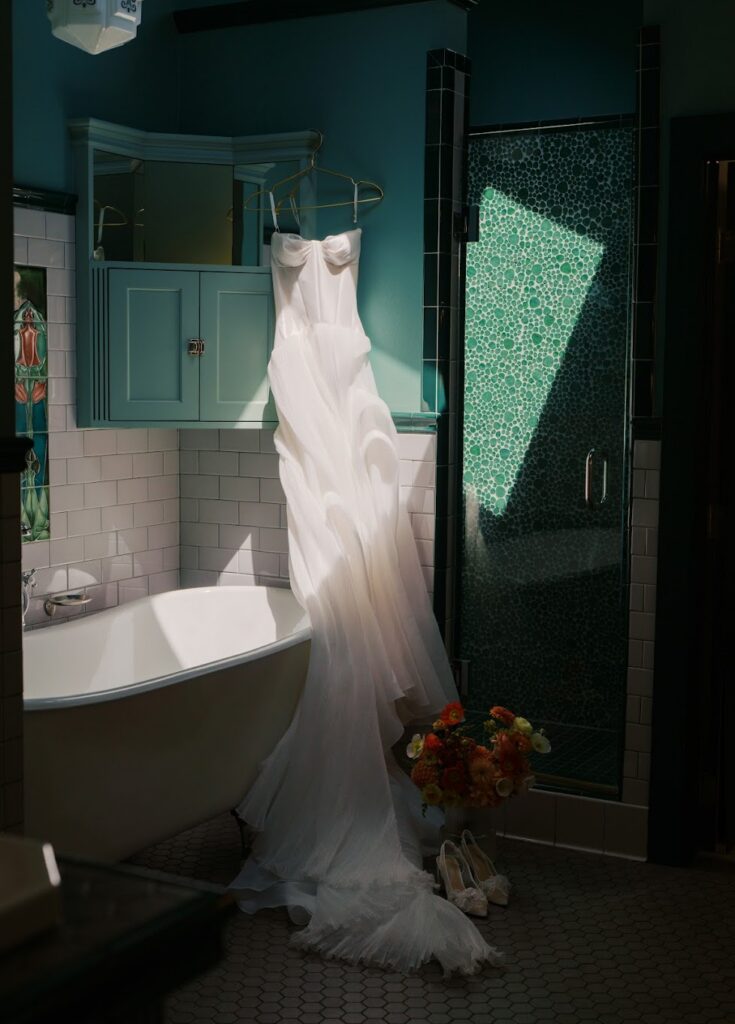
Getting-ready spaces that feel like real rooms. Many modern venues give you a “bridal suite” that’s basically a beige conference room with a mirror. Historic venues give you actual rooms — bedrooms, dressing rooms, glam suites — that feel like somewhere a person could actually exist for six hours while drinking mimosas with eight of her closest friends. (You can see the historic 1881 mansion photos in our mansion gallery if you want a sense of what those rooms actually look like.)
An automatic vibe. You don’t have to design a “look” for your wedding. The venue is doing 70% of the work for you. Less stress, fewer decisions, lower decor budget.
The Honest Tradeoffs
I’m not going to pretend historic venues are perfect, because no venue is and you deserve the real version. The biggest one is the one nobody warns you about until you’re deep into planning:
Most historic mansions don’t have a reception building. This is the trap. The mansion is gorgeous, you fall in love on the tour, you sign the contract — and then you find out the mansion itself can really only be used for getting ready and pre-ceremony. There’s nowhere on the property to actually host 150-200 guests for dinner and dancing. Your options become: rent a tent in the yard (a real tent for a real wedding in Austin runs upwards of $12,000 once you add lighting, flooring, climate control, and rentals), or split your reception across two locations. Either way, you’re paying again — sometimes a lot — to solve a problem you could have avoided.
Restrictions on what you can hang, move, or knock against. When the walls are 140 years old, the venue is going to (rightfully) protect them. Some couples find this charming; some find it limiting. Worth knowing in advance.
Accessibility can be a real thing. Old buildings often have stairs, narrow doorways, uneven thresholds. If you have guests with mobility needs, ask before you fall in love.
None of these are deal-breakers. They’re tradeoffs. The point isn’t that historic venues are bad — it’s that you should know what you’re actually signing up for, especially the tent thing. Nobody mentions the tent thing until it’s too late.
Modern Wedding Venues in Austin: What You Actually Get
A well-designed modern wedding venue gives you climate control that actually works in Texas summer, predictable infrastructure (power, kitchens, bathrooms, sound, lighting), a blank-canvas aesthetic that bends to your vision, and a real reception hall so weather isn’t a crisis. The honest tradeoff: without architectural character, modern venues can feel sterile until you light and decorate them — the soul has to come from you.
Now flip it.
A well-designed modern venue solves most of the logistical headaches that historic venues create. I want to be careful about that word “well-designed,” because not all modern venues are created equal — some get built without ever consulting the planners and caterers and DJs who actually have to work in them, and those ones can be just as frustrating as a 140-year-old mansion with three window units. But when a modern venue is built by people who actually know what an event needs, it’s a different experience entirely.
Climate control that actually works. This is the biggest one in Texas. A purpose-built modern reception hall has zoned HVAC, properly insulated walls, and an AC system designed to handle 200 bodies and a packed dance floor in August without breaking a sweat. (Literally.)
Predictable everything. Power outlets where caterers need them. Kitchens that pass inspection. Enough bathrooms for your guest count. Lighting that can dim. Sound systems that work. The unsexy infrastructure stuff that makes the difference between a smooth day and a slightly chaotic one.
A blank canvas. Modern venues are usually neutral on purpose, which means you get to do the design. If you have a strong vision — a specific color palette, a particular floral aesthetic, a “moody minimalist” Pinterest board — a modern venue will let it shine without competing.
Capacity flexibility. Most modern wedding halls were built to scale. 80 guests, 200 guests, 250 guests — the room can usually adapt without it feeling weird. (You can see the reception hall photos in our hall gallery if you want a sense of how a purpose-built modern reception space actually looks.)
Weather backup is built in. A modern venue with a real reception hall means you don’t have to scramble for a tent if the forecast turns. (Worth asking specifically about ceremony rain plans too — some venues handle this with a covered outdoor option, some move you fully indoors. Either is fine; you just want to know which.)
The Honest Tradeoffs
They can feel sterile. I’m just saying it. A lot of modern venues, until you light them and decorate them, feel like a very nice corporate conference center. The “blank canvas” thing cuts both ways — it’s flexible, but it requires you to bring the soul.
Photos require more work. Without architectural character to lean on, your photographer has to create the visual interest. That usually means either a strong floral budget, dramatic lighting, or finding interesting backdrops on the property. (None of these are bad — they’re just real.)
Less narrative. “Built in 2019 by a developer specifically for events” is not a story your guests will repeat at brunch the next morning. If you want your venue to mean something beyond beautiful, modern venues sometimes have to work harder.
Getting-ready space is often an afterthought. Even in nice modern venues, the bridal suite is frequently a small, white, weirdly-shaped room with one mirror and an outlet. You’ll probably still be ready on time — but the morning won’t feel like the photos.
Again — not deal-breakers. Just real.
Choosing Between Historic and Modern Wedding Venues in Austin: 5 Questions That Decide It
Most couples don’t need a longer pros-and-cons list to decide between historic and modern — they need the right five questions. What you picture first (place vs. party), how much your guests’ physical comfort matters, your top-three non-negotiables, your real weather tolerance, and who’s traveling for the wedding usually decide it for you in under ten minutes.
Okay. So you have the tradeoffs. How do you decide?
In my experience, most couples don’t really need a longer pros-and-cons list. They need to be asked the right five questions. Here they are.
1. WHEN YOU IMAGINE YOUR WEDDING, WHAT DO YOU SEE FIRST – THE SPACE OR THE PARTY?
If the first image in your head is a place — a porch, a staircase, a garden — you’re a historic person. If the first image is a vibe, a moment, a packed dance floor, you’re probably a modern person. The thing your brain reaches for first tells you what matters most to you.
2. HOW MUCH DO YOU ACTUALLY CARE ABOUT YOUR GUESTS’ PHYSICAL COMFORT?
Be honest. Some couples genuinely don’t mind if Aunt Linda is fanning herself with a program — the photos are going to be amazing. Other couples will not be able to enjoy the night if anyone is uncomfortable. Both are valid. But if you’re in the second camp and you book a venue without proper climate control in August, you will spend your entire reception worrying about it.
3. WHAT DOES YOUR “NON-NEGOTIABLE” LIST LOOK LIKE?
Make a list of the three things that absolutely have to be right for the wedding to feel like yours. Now look at it. Are they all things a historic venue does well (story, character, charm)? Or are they all things a modern venue does well (control, flexibility, comfort)? The list usually picks for you.
4. HOW WEATHER-TOLERANT ARE YOU, REALLY?
Not “I’m flexible.” Everyone says that. I mean: if it rains exactly during your ceremony window, are you going to be sad, or are you going to roll with it? Historic venues often require you rent an outdoor tent (which of course, comes with a hefty price tag). Modern venues often don’t. Know yourself.
5. WHO’S TRAVELING FOR THIS WEDDING – & WHAT DO THEY NEED?
If most of your guests are local, comfort and accessibility matter less. If you have grandparents flying in, friends with babies, anyone with mobility considerations, or a bunch of out-of-town guests who’ll be there all day — those needs should weigh heavier than aesthetic preference.
If your answers all point one direction, go that direction with confidence. You have your answer.
But if your answers are split — some pointing historic, some pointing modern — keep reading. Because there’s a third option most couples don’t know exists.
Hybrid Wedding Venues in Austin: The Historic-and-Modern Third Option
A small number of Austin wedding venues combine both — an authentically historic structure and a separate, purpose-built modern reception hall on the same property. They’re rare because doing both well requires actual age in the historic building, dedicated modern infrastructure, enough acreage that the two don’t visually fight, and an owner committed to maintaining both. When the combination works, it removes the historic-or-modern tradeoff entirely.
Here’s the thing nobody tells you when you start venue shopping.
There is a small category of Austin wedding venues that don’t make you choose between historic and modern. They give you both. On the same property. On the same day. Without compromise.
These venues are rare for a reason. To exist, they need:
- An actual historic structure (not “historic-style” — actually old)
- A separate, purpose-built modern reception space
- Enough land to fit both without one ruining the feel of the other
- An owner who decided, at some point, “we’re going to do both well instead of half-doing one”
That last point is the rarest. Most properties pick a lane because doing both well is expensive and complicated. You need to maintain a 19th-century building (which is its own ongoing labor of love), and build a modern hall to current code, and have enough acreage that the two don’t visually fight each other, and make sure the flow between them feels like one cohesive day instead of two separate weddings stitched together.
When a venue pulls it off, though, the magic is real. You get the morning in a getting-ready room that feels like a movie set. You get a ceremony with character — under oaks, in a garden, in the courtyard, somewhere with story. You get cocktail hour flowing from the historic mansion, through the courtyards, to a modern hall that makes your guests pull out their phones. And then, when the sun goes down and everyone needs to actually eat dinner and dance, you’re already in a climate-controlled space that solves every logistical problem your historic-loving heart was quietly worried about.
It’s the answer to the question you didn’t realize you were asking.
Hybrid Wedding Venue in Austin: What “Both” Looks Like at The Grand Lady
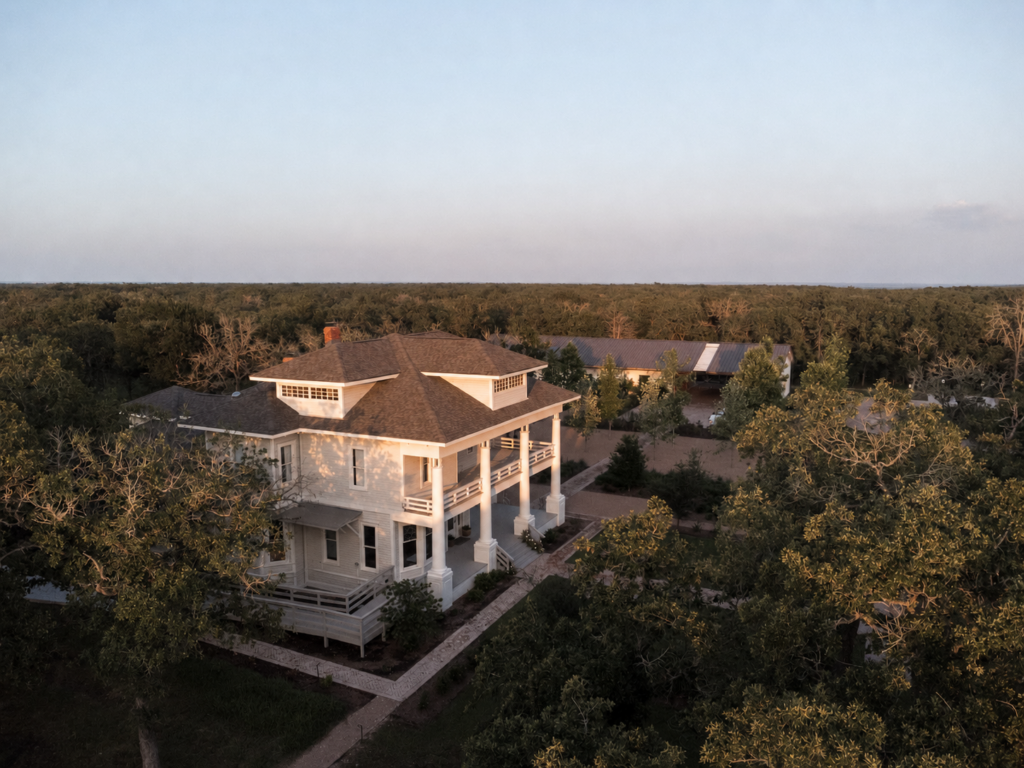
The Grand Lady is an 1881 mansion on 20 acres about 25 minutes east of downtown Austin, paired with a 3,500+ square-foot modern climate-controlled reception hall about 50 yards away and a half-acre cut flower garden behind the property. The mansion handles getting-ready, ceremony backdrops, and historic charm; the modern hall handles dinner, dancing, and Texas weather. The flow between the two is the whole point.
I should probably acknowledge here that I’m wildly biased — I own one of these venues. So take what comes next with that grain of salt. But I’m going to walk you through it anyway, because it’s the most concrete way to show you what a hybrid venue actually feels like in practice.
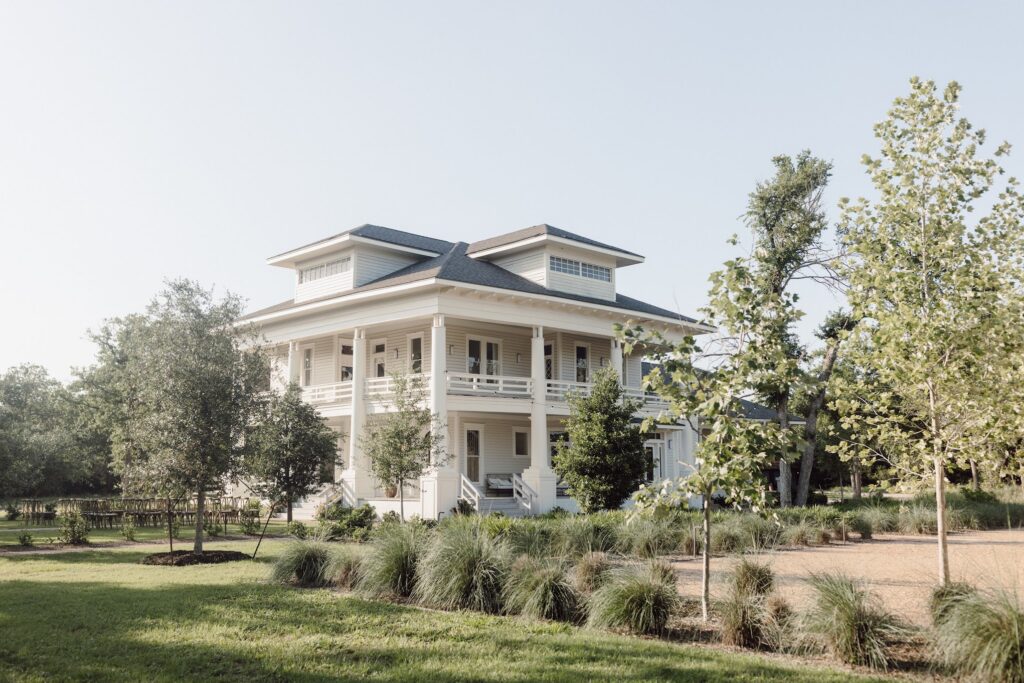
The Grand Lady is an 1881 mansion that sits on 20 acres in Austin, Texas, about 25 minutes east of downtown Austin. It was originally built in Bartlett, Texas as a wedding gift for Mrs. Walton (which I will never not think is the most romantic origin story in Austin), relocated to its current property in 1970, and fully restored in 2019 — by me, my husband Sean, and my dad. God bless those men. It’s a 4,000 square foot home with eight rooms, including original ornamental woodwork and stained glass details (like the keyhole stained glass window that’s a nod to the original Victorian design), all of which get used throughout the wedding day.
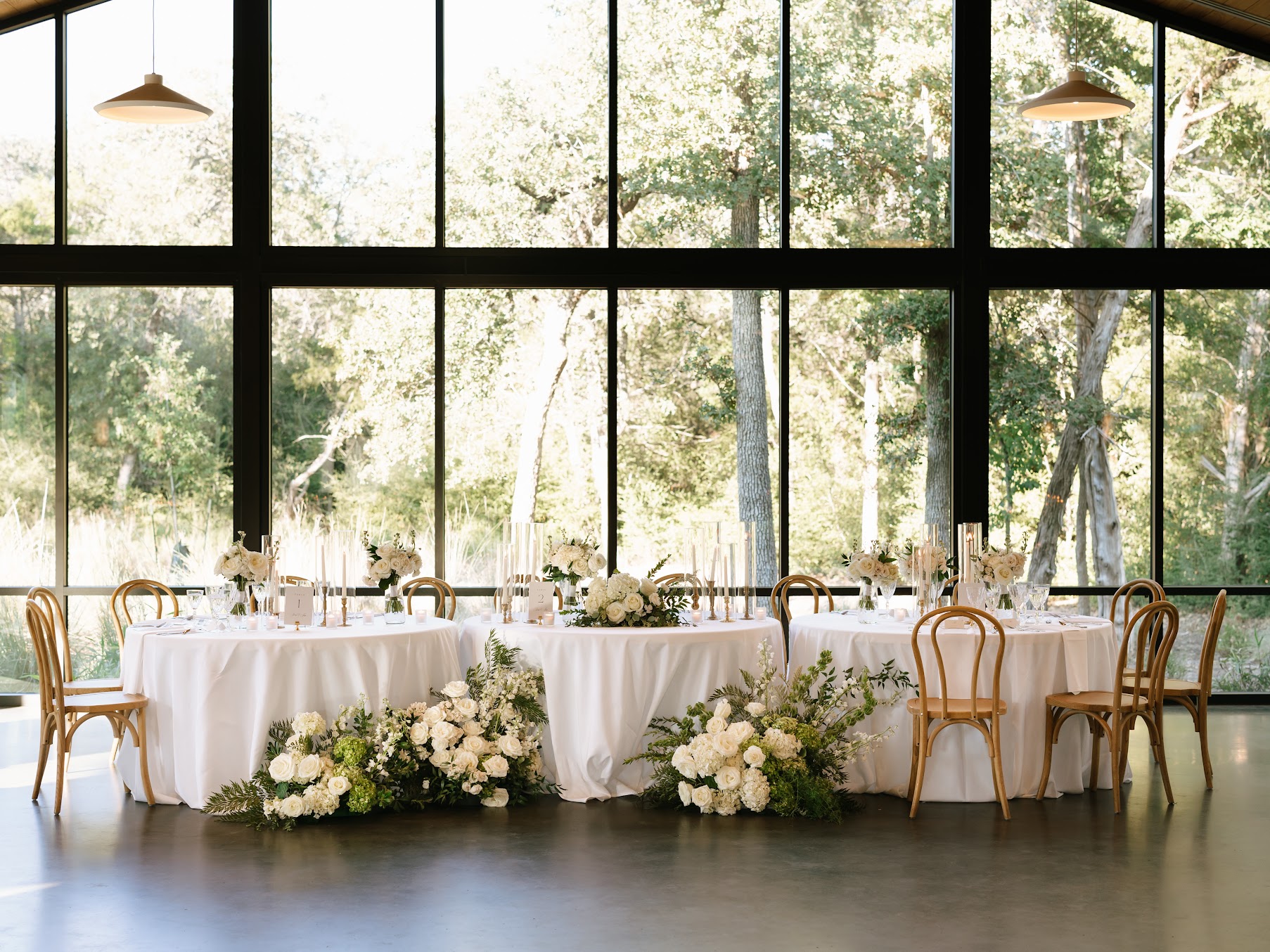
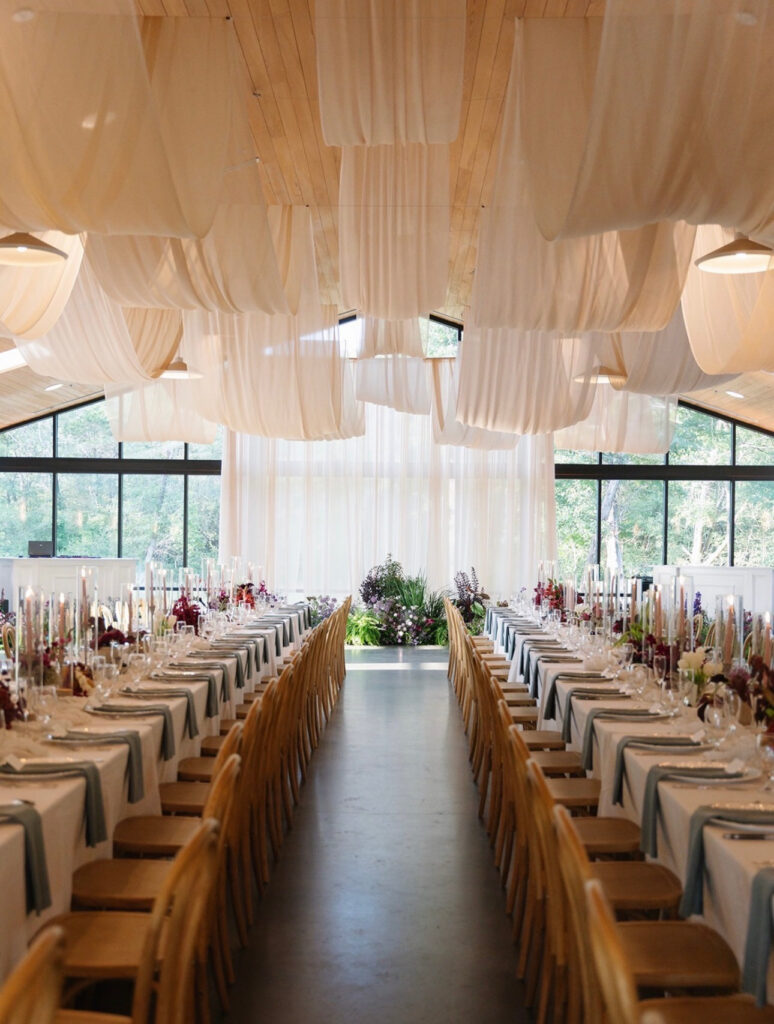
About 50 yards away, sits our modern reception hall. It’s over 3,500 square feet of open-concept celebration space, climate-controlled, with six full-height skylights and a glass endcap that opens onto the grounds. It seats 200 with room for a live band, and we cap weddings at 250 guests total. We worked with planners and caterers during construction so that the room would actually function for an event — not just look good on a website.
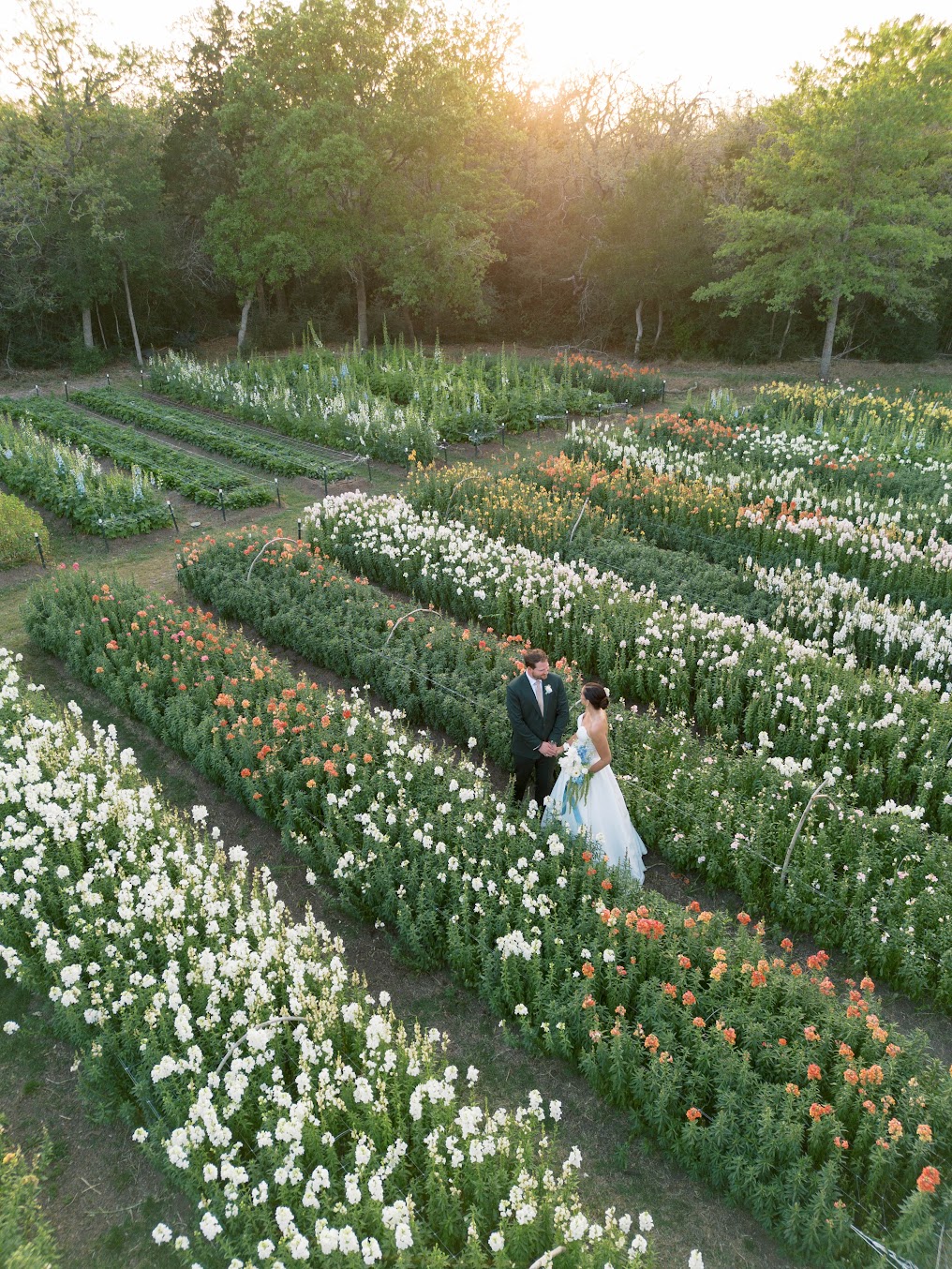
Behind the house, tucked in the back of the property is a half-acre cut flower garden — 48 raised beds and a 60-foot pergola that doubles as a ceremony backdrop. (The garden is also where my husband Sean spends every weekend obsessing over dahlias and soil pH — that’s the story I tell over in garden wedding venues in Austin, if you want the deeper version.)
The result is that the entire day flows between historic and modern in a way that doesn’t feel forced.
I realize I sound like a real estate listing right now. I genuinely can’t help it. This is the nerdy part of running a venue — you really do start narrating it like a tour. Let me just walk you through an actual day instead. That’ll make more sense.
A Real Day at a Hybrid Wedding Venue in Austin: How it Unfolds
Morning getting-ready happens inside the historic mansion’s real bedrooms and dressing rooms. First-look photos use the porches, oaks, or garden — couple’s choice. Ceremony is on the lawn or under the 60-foot pergola in the flower garden, with two real rain plans (the modern hall or the covered awning). Cocktail hour flows through the courtyards and gardens; reception moves into the climate-controlled hall for dinner and dancing. No tents, no scrambling.
Here’s how a wedding day usually unfolds when you have both options on the same property.
Morning. The wedding party gets ready inside the mansion. The bride and her people take over the upstairs rooms — there’s space for hair and makeup, a walk in closet for dresses, a couch big enough to actually sit on, windows that let in real light. The groom and his people get a separate suite. Everyone’s in real rooms, not airport lounges.
Pre-ceremony. First-look photos happen wherever you and your photographer decide makes sense that day — the porch, under the oaks, in the garden. There’s no shortage of beautiful spots, and the call is yours. (Pro tip: this is the part of the day where photographers really start grinning. They love this property.)
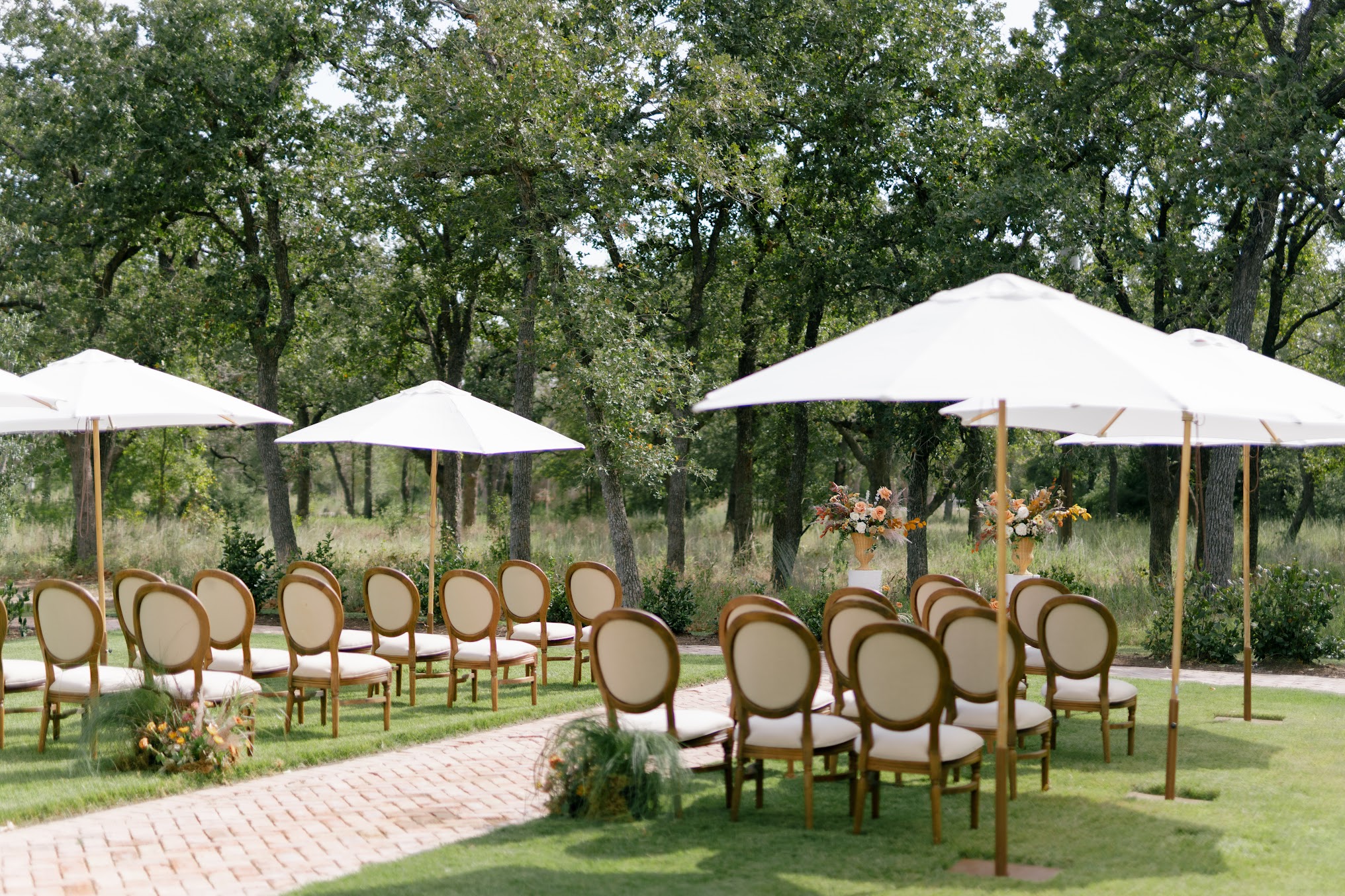
Ceremony. Couples usually pick between the ceremony lawn at the front of the mansion and the flower garden under the 60-foot pergola. The garden ceremonies are the ones I love most — there’s something about getting married surrounded by flowers that were planted months ago specifically for that day. And if Texas weather decides to Texas, you’ve got two rain plans, not one: the climate-controlled reception hall, or the covered awning, which honestly has one of the best views on the entire property. Plan B feels like Plan A. No scrambling, no tents, no panic.
Cocktail hour. Guests flow between the courtyards and the gardens. The courtyards are heavily landscaped with mature trees, so there’s plenty of shade. If your ceremony was in the garden, that becomes the cocktail hour space too — guests stay surrounded by the flowers they just watched you walk down the aisle through. The whole property is in use, and it all feels like one wedding instead of a series of disconnected vignettes.
Reception. Sun starts going down, dinner is ready, and you walk your guests into the modern hall. AC is already going. Lighting is set. The room is glowing. Nobody is sweating, nobody is wondering where the bathroom is, nobody’s grandmother is having a moment about the heat. You eat. You dance. The room is built to hold a live band and a packed floor without any of the awkwardness — everyone can hear, everyone can move, and everyone is comfortable. Nobody is improvising.
Late night. When the night winds down, the mansion is right there to disappear into for a quiet moment with your person. Or not. You do you.
The point is: you don’t trade anything. You don’t pick a wedding where the photos are stunning but the guests are miserable, or one where the guests are comfortable but the photos look like every other event in town. You get both, and it doesn’t feel like a compromise — it feels like the way a wedding day is supposed to flow.
That, to me, is the case for hybrid venues. And it’s why we built Grand Lady the way we did.
Historic or Modern Wedding Venue in Austin: Which One is Right For You?
If the five questions above gave you a clear lean toward historic or modern, trust it and book. If you keep getting torn — loving the character of historic venues but worried about your guests in August, or loving the comfort of modern venues but missing the soul — that’s a signal you may not be choosing between styles. You might be looking for a venue that doesn’t ask you to choose at all.
If the framework above made it obvious — go with that. Don’t overthink it. If the answer is “definitely historic,” book the historic venue and don’t look back. If the answer is “definitely modern,” same thing.
But if you keep finding yourself torn, that’s information. It usually means you’re not actually choosing between styles — you’re choosing between things you don’t want to give up. And the right answer might not be picking a side. It might be finding a venue that doesn’t ask you to.
If you want to come see what a both/and venue actually feels like, schedule a tour at The Grand Lady. No pressure. Just come walk the property and see if it answers the question you’ve been quietly wrestling with.
And if the part of venue shopping that’s actually wearing you out is the vendor shopping — finding a planner, caterer, florist, DJ, and bar service to layer on top of the venue choice — that’s the other major decision guide worth reading. The all-inclusive wedding package in Austin post walks through who’s in the lineup, what the prearranged pricing looks like, and which days it’s available.
And if you’ve already fallen in love with another venue? We’re happy for you — truly. But I’d still encourage you to ask the five questions above before you sign anything. Even if the answer isn’t us, the answer should at least be you.
Frequently Asked Questions
Yes — but very few. To genuinely qualify, a venue needs an authentically historic structure (not “historic-style”), a separate dedicated reception space that can actually host dinner and dancing, and enough land for both to coexist without one ruining the feel of the other. A small handful of Austin venues offer some version of this combination, but the way they handle it varies a lot — some pair a historic mansion with a hotel ballroom, some retrofit a reception space inside the historic structure, and some pair the mansion with a separate purpose-built hall on the same property. The Grand Lady falls into that last category: an 1881 mansion paired with a purpose-built modern reception hall, designed in collaboration with planners and caterers from the start, on 20 acres in Austin, Texas, with a half-acre working cut flower garden tucked at the back of the property. If you’re shopping for a “both/and” venue, the question to ask is where dinner and dancing actually happen — that’s where the differences between hybrid venues become clear.
This is the question most couples don’t think to ask until it’s too late. Most historic Austin wedding mansions don’t allow guests inside the mansion at all during the wedding — the space is reserved for the wedding party for getting ready and pre-ceremony moments, not for dinner and dancing. That means receptions usually happen in one of three places: a separate reception hall on the property (only some historic venues have one), a hotel ballroom (if the venue is hotel-based), or a tent in the yard. Tents look beautiful in photos, but a fully outfitted wedding tent in Austin runs upwards of $12,000 once you add lighting, flooring, climate control, and rentals. Always ask, on your tour, exactly where dinner and dancing will happen — and whether that space is included in the venue rental or will require an additional rental.
A historic wedding venue is housed in a building of historical or architectural significance — typically pre-1940s, often a mansion, farmhouse, mill, or restored estate. They offer built-in character, story, and visual richness, but may have limitations around climate control, capacity, and accessibility. A modern wedding venue is purpose-built for events, usually constructed in the last 5-15 years, with full climate control, custom event infrastructure, and flexible blank-canvas spaces. Modern venues solve logistical challenges but may require more design effort to feel personal.
It depends on what you’re comparing. Base venue rental in Austin runs roughly $4,000 to $14,500, varying by day of week and season — historic and modern venues land in similar ranges at the rental level. Where cost differences show up is in what’s not included. Some historic venues don’t have a reception space, which means you’re renting a tent ($12,000+ for a fully outfitted wedding tent in Austin with lighting, flooring, climate control, and furniture). Others require extensive decor to make the space event-ready. Modern venues tend to include more infrastructure in the rental — climate control, built-in lighting, tables and chairs — but may charge more for the “blank canvas” styling that makes the space feel personal. The real comparison isn’t rental price vs. rental price — it’s total cost once you add what each venue doesn’t include. Ask for a full cost breakdown on every tour. Taxes & fees not included. At The Grand Lady, book with Grand Lady Floral for a $500 discount on venue rental. For the full month-by-month pricing breakdown, request our pricing guide.
It varies wildly. Many historic mansions were built long before climate control existed, and some rely on fans or open-air flow instead of real AC. The question to ask isn’t “does the venue have AC?” — it’s “does the space where my guests will eat dinner and dance for four hours have reliable, full climate control?” At The Grand Lady, the 1881 mansion is climate-controlled for getting ready, and dinner and dancing happen in the modern reception hall — over 3,500 square feet of fully air-conditioned space built specifically for events.
The Grand Lady is a family-owned wedding venue in Austin, Texas, operated by Katie and Sean West. The 1881 mansion sits on 20 acres about 25 minutes east of downtown Austin and includes a fully restored historic structure, a modern climate-controlled reception hall, and a half-acre on-site flower garden. To schedule a tour at The Grand Lady, pick a time that works for you.
+ view the comments